October 13, 2026
Food & Culture
How to say a nut allergy in Chinese so staff understand, what the eight allergen categories on a Chinese label mean, and what changes in 2027.
• Why translation apps let you down with allergies • What to say before you order, and what staff actually hear • The label: eight categories, and where a nut can hide • What changes in 2027, and what does not • Restaurants sit outside the labelling rules • Three fallbacks when communication fails • What we deliberately do not claim
A nut allergy in China runs into two systems, and only one of them has anything written down. On a packet there is a label, and from 16 March 2027 that label must name allergens in a fixed way. At a table there is no label at all: neither the standard nor the regulation behind it covers food cooked on the premises.
Speech first: the words that carry the meaning, and what a kitchen hears back. Then print: eight allergen categories, the exemptions that keep peanuts off a legal label, and why none of it binds before 2027. It sits inside our guide to eating and drinking in China.
Ask a dictionary app for nut and you may get a threaded fastener: 螺母, the piece that takes a bolt. The food sense splits in two. 坚果 covers tree nuts — walnut, cashew, almond, hazelnut, pistachio — and 花生 is peanut, a separate word with no shared root and its own entry on a label.
Chinese says 我对花生过敏: allergic to peanuts. A translation app may offer 我有花生过敏 instead: decodable, but it reads like a medical record entry, a condition you have, not a request you are making. Then 过敏 itself: in casual use it covers “that dish does not agree with me” as readily as a medical allergy. Severity has to be said out loud: 严重, or 吃了会危及生命.
Negation fails too: “no nuts” comes back as 没有坚果, which describes an empty bowl rather than instructing a cook.
Three sentences do most of the work. The first two name 花生 (peanut) and 坚果 (tree nut) rather than one word, because neither covers the other. The third names objects a cook can act on: a wok, a spatula.
| What you need to say | Chinese | Why the direct translation fails |
|---|---|---|
| I am severely allergic to peanuts and tree nuts — eating them would endanger my life | 我对花生和坚果严重过敏,吃了会危及生命。 | “Nut allergy” tends to come back as 坚果过敏, which drops 花生 entirely, and a bare 过敏 is heard as a mild intolerance. Severity needs its own clause. |
| Does this dish contain peanuts, peanut oil or tree nuts? | 这道菜里有花生、花生油或者坚果吗? | “Nut” alone may return 螺母, a piece of hardware, and “oil” returns 油 without saying which oil. Name the dish, the oil and both allergens. |
| Please use a clean wok and spatula, not the ones used for other dishes | 请用干净的锅和锅铲,不要用炒过其他菜的。 | “Cross-contamination” translates as 交叉污染, a compliance term that belongs in an inspection report, not a kitchen. Phrase it as an action on named objects. |
Show the screen rather than reading it aloud: the characters, not your pronunciation, are what get read. Read it yourself first; a sentence built by an app is the app’s guess.
The clause that closes the negotiation is 一点也不能吃, not even a little. 少放一点 describes a taste; 一点也不能吃 describes a limit. Ask in order: 这道菜里有花生、花生油或者坚果吗? Then what it is cooked in, and last what goes on top. The middle answer is where oil comes up.
Table-side phrases and etiquette are in ordering and table etiquette in China. The other half is what a package can tell you.
The standard behind a packet is GB 7718-2025, issued by the National Health Commission and the State Administration for Market Regulation in Announcement No. 2 of 2025, dated 16 March 2025, one of 50 standards and 9 amendments. Eight allergen categories must be declared wherever used as an ingredient. Peanuts are one entry, tree nuts another; that is why the sentences above use two words.
| Category on the label | What it covers | Where it turns up |
|---|---|---|
| Cereals containing gluten | Wheat, barley, rye, oats | 小麦粉 · 面条 · 酱油 |
| Crustaceans | Shrimp, crab, crayfish | 虾 · 蟹 · 虾酱 · 虾皮 |
| Fish | Fish and fish products | 鱼露 · 鱼丸 · 鱼干 |
| Eggs | Egg and egg products | 蛋清 · 蛋黄 · 蛋液 |
| Peanuts | Peanut and peanut products | 花生 · 花生酱 · 花生碎 |
| Soybeans | Soybean and soy products | 大豆 · 豆浆 · 豆腐 · 酱油 |
| Milk, lactose included | Milk and dairy products | 乳粉 · 奶油 · 黄油 · 乳糖 |
| Nuts | Walnut, cashew, almond, hazelnut, pistachio | 核桃 · 腰果 · 杏仁 · 榛子 |
花生 and 坚果 are separate entries, so a label naming one has said nothing about the other. The declaration need not sit in its own box: under Annex D a producer may bold the allergen inside the ingredient list, or gather them into a notice beside it. Scan 配料表 for the characters; the 致敏物质提示 box is optional, the ingredient list is not.
China’s food allergen labelling rules draw a hard line at eight categories: those must be declared, everything else is voluntary. The standard’s own examples are 芝麻及其制品 (sesame) and 椰子及其制品 (coconut). A compliant label can leave 芝麻 out entirely.
Annex D.4 exempts deeply processed ingredients whose allergenic protein has been removed. The entry for “soy and peanut processing products” names refined peanut oil outright. A bag of fried snacks can carry a complete ingredient list that never says 花生. The exemption says the oil need not be declared, not that it is safe for you, and says nothing about oils not described as refined.
The mandatory version begins on 16 March 2027. The announcement text carries no implementation date; that comes from the commission’s own September 2026 reply to a CPPCC proposal. The Food Labelling Supervision Measures, SAMR Order No. 100, takes effect the same day.
Under the 2011 edition, allergen declaration was voluntary, so a packet printed two years ago may name no allergens and still be legal. Food produced before that date may be sold until its shelf life runs out. 生产日期 tells you which rule your packet answers to.
Allergens may be carried over on a shared line, and a warning is still only encouraged, not required, in the standard text. The commission’s Q&A adds the part that matters: printed or not, producers must still manage production hygiene. A missing “may contain” line does not mean the risk is absent; it means nobody was obliged to warn you.
The standard bans 不添加 and 不使用 outright, and permits 无 or 不含 only where the component is genuinely at zero and backed by tests. A no-nuts line on a packet is only as good as the test behind it.
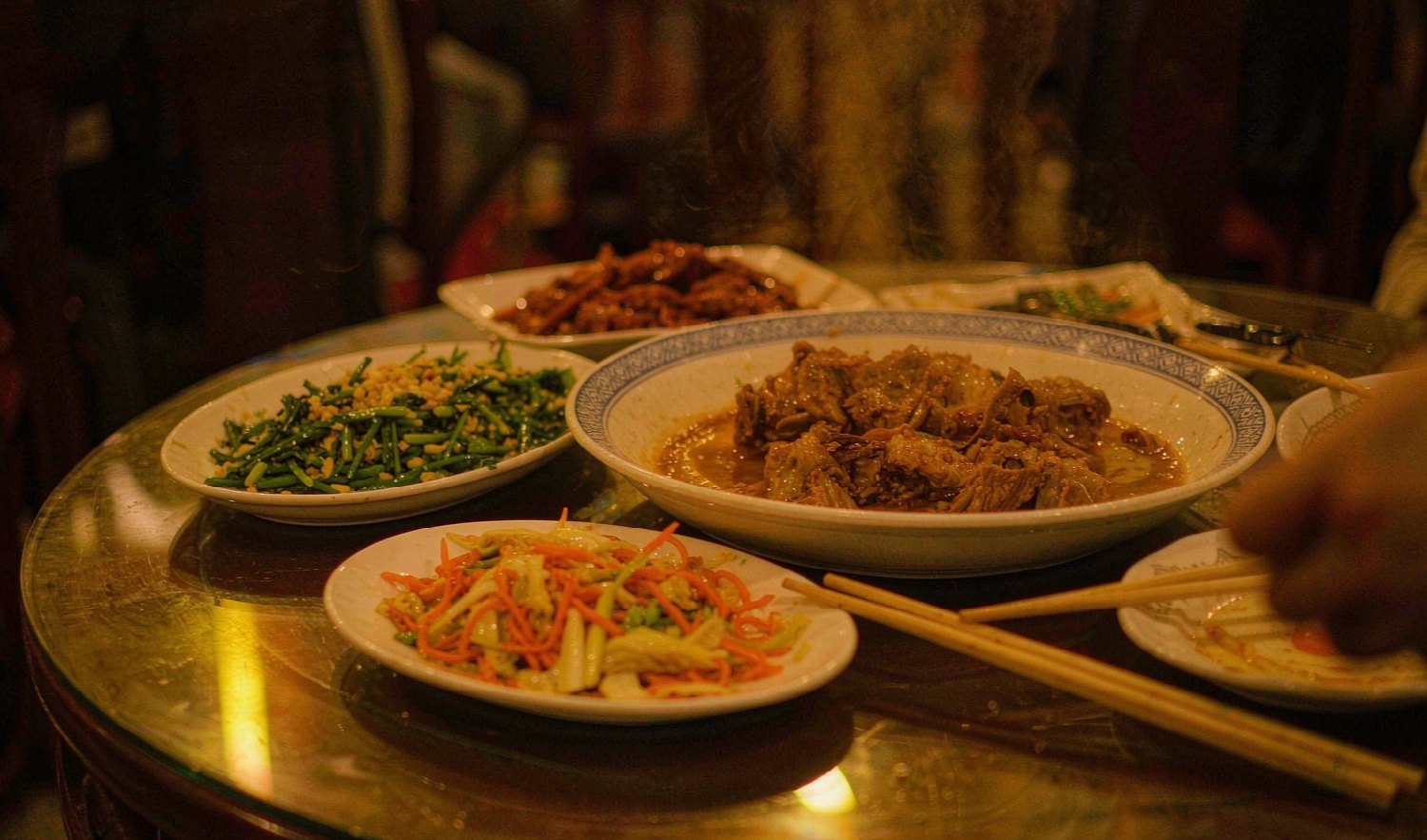
In Chinese restaurants there is no mandatory allergen label to read. Everything above describes packets; at a table none of it applies, for two written reasons.
Article 51 of SAMR Order No. 100 (食品标识监督管理办法) puts food prepared and sold on the premises outside the Measures. Article 3 of the commission’s Q&A on GB 7718-2025 lists “catering food and food prepared and sold on the premises” among the cases the standard does not cover.
That is a limit on how far a labelling rule reaches, not a statement that a kitchen owes you nothing: if an answer comes, it will be spoken by a person, with no 配料表 to check it against.
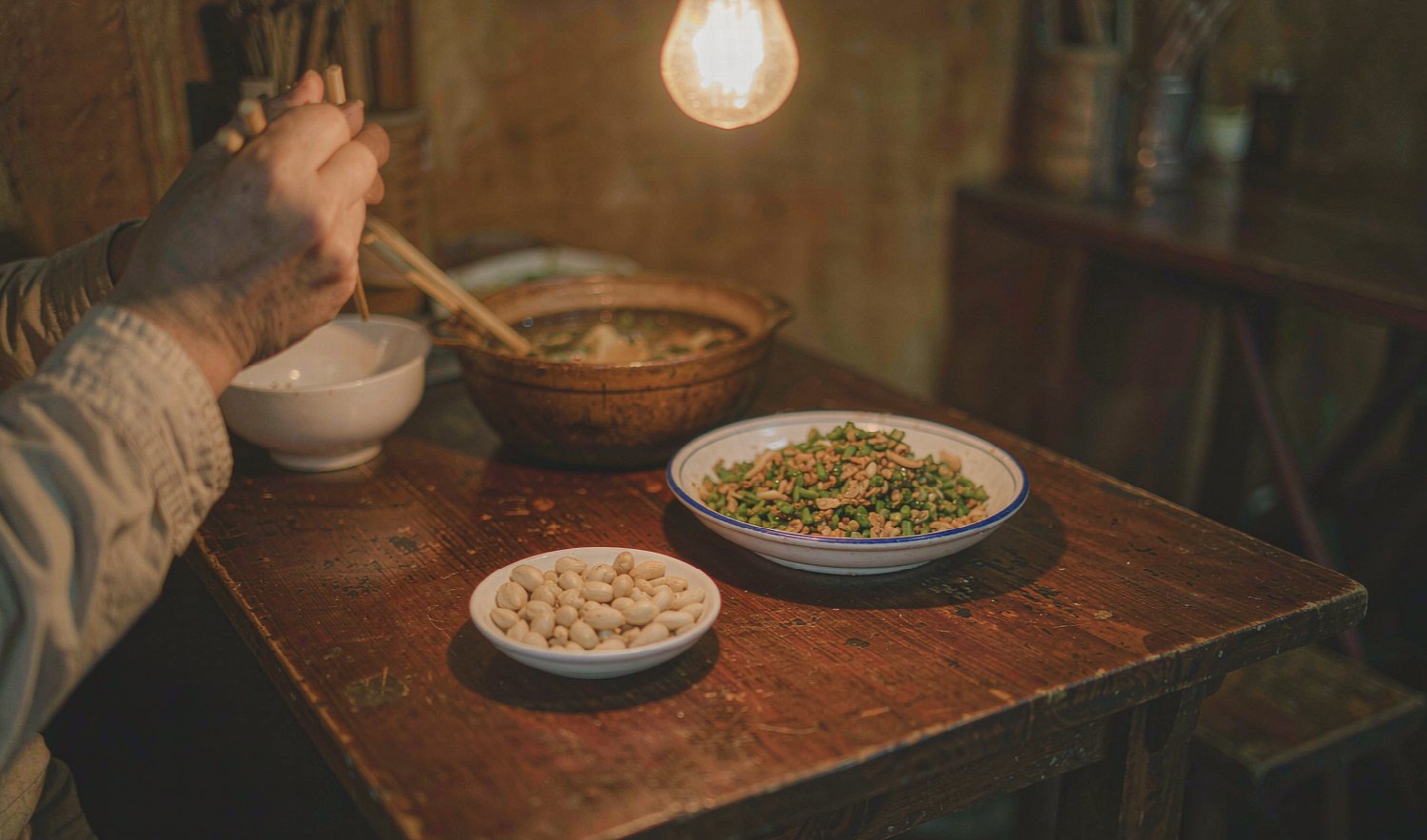
Ask about objects, one at a time. First the wok (请用干净的锅和锅铲,不要用炒过其他菜的。), then the oil (这道菜是用什么油做的?), then the dip (这个酱里有没有花生酱或者芝麻酱?), then the garnish (上面撒的是什么?). Four questions in one breath get one answer.
If the restriction is wider than nuts, eating in China with a dietary restriction covers the general case.
Plan on one meal where the answer does not arrive.
花生 and 坚果 written large survive a noisy room. Ask staff to write down what is in the dish; a written answer is one you can check yourself.
A dish whose sauce comes on the side keeps the last step at your table; plain rice or noodles give you a base one bad order cannot spoil.
A shrug, a laugh, or a confident 没有 that lands before you finish the question are the same answer. Leaving is a legitimate outcome, and if you would rather fix the order, how to order food in China covers the QR menu and paying at the table.
Five things are absent on purpose.
Both instruments take effect in March 2027, so check the 2025 announcement and the standard text, not a travel site — this one included.
• Put 花生 and 坚果 on your phone before you fly — one word does not cover the other • Show the sentence on your screen and read the characters yourself before handing the phone over • Ask about the wok, the oil, the dip and the garnish one at a time, and wait for each answer • Scan 配料表 for 花生 and 坚果 instead of looking for a separate allergen box • Check 生产日期 before trusting an ingredient list on packaged food you buy • Read a missing “may contain” line as no information, not as reassurance • Agree with your companion in advance what you do when the answer is unclear
• Typing “nut allergy” into a translation app and using whatever comes back • Naming peanuts only, when 坚果 is a separate word and a separate label category • Reading a clean ingredient list as proof that no peanut oil is in the product • Treating a “no nuts” line on the front of a pack as a tested clearance • Waiting for a restaurant to volunteer allergen information instead of asking about named objects
How do I say I have a nut allergy in Chinese?
Show this sentence: 我对花生和坚果严重过敏,吃了会危及生命。 It says you are severely allergic to peanuts and tree nuts and that eating them would endanger your life. Two things in it matter. 花生 and 坚果 are different words — peanut and tree nuts — and no single Chinese word covers both, so the sentence has to name both. And 过敏 on its own is often heard as mild discomfort, so severity has to be its own clause rather than something the listener infers. Do not build this sentence with a translation app: English “nut” can come back as 螺母, a threaded fastener, and “nut allergy” arrives as 坚果过敏 with the peanut gone. Show the characters on your screen, and read them yourself before you hand the phone over — a sentence you cannot read is a sentence you cannot check.
Do Chinese food labels list allergens?
On prepackaged food, eight allergen categories must be declared where they are used as an ingredient, and peanuts and tree nuts are two separate entries — 花生 and 坚果. That becomes mandatory on 16 March 2027, when GB 7718-2025 and SAMR Order No. 100 take effect. Until then, and for stock produced before that date, labels may follow the older voluntary rules: prepackaged food made before 16 March 2027 can be sold until its shelf life ends, so 生产日期, the production date, is the field that tells you which rule a packet answers to. A label also does not have to gather allergens into one box — they may be bolded inside the ingredient list instead. And compliance is not clearance: under Annex D.4 refined peanut oil is exempt from declaration, sesame may be declared voluntarily, and a “may contain” warning for shared lines is encouraged rather than required.
Are restaurants in China required to label allergens?
Not in the way a packet is. Article 51 of the Food Labelling Supervision Measures (SAMR Order No. 100) states that the labelling of food prepared and sold on the premises in the catering sector is not governed by the Measures, and the National Health Commission’s official Q&A on GB 7718-2025 places catering food and food prepared and sold on the premises outside that standard’s scope as well. That is a statement about how far a labelling rule reaches. It is not a claim that a restaurant owes you nothing, and this page does not make that claim. Practically, it means there is no ingredient list to read at a table, so the question has to go to a person. Ask about named objects one at a time: the wok, the oil, the dip, the garnish. If the answer is unclear, treat it as a no.